Long-term care (LTC) is usually discussed as a health care concern. But for retirees, the cost of care can create another challenge that is easy to overlook: a chain reaction of tax consequences that can put additional pressure on retirement savings.
When clients need money for home health care, assisted living, memory care or nursing home services, they may turn to retirement accounts to cover the expense. If much of their savings are held in tax-deferred accounts such as traditional IRAs, accessing those dollars can increase taxable income.
That can set off a costly cycle.
When LTC Costs Create a Need for Cash
Long-term care expenses can be significant, and they don’t always arrive on a predictable schedule.
Even clients who have accumulated substantial retirement assets may discover that their regular retirement income isn’t enough to cover an extended period of care. When additional cash is needed, traditional IRAs and other qualified retirement accounts can become a natural source of funds.
The challenge is that distributions from these accounts are generally taxable.
As a result, a client may need to withdraw considerably more than the actual cost of care to generate the net amount needed to pay the bill.
Larger IRA Withdrawals Can Mean More Taxable Income
Traditional IRA distributions generally increase taxable income and can increase a retiree’s Modified Adjusted Gross Income (MAGI).
A large distribution to cover care expenses could potentially move a client into a higher tax bracket and affect other areas of their retirement finances.
Suddenly, the cost of care isn’t the only expense.
The client may also face:
- Higher federal income taxes
- Greater taxation of investment income
- Additional Medicare-related costs in certain circumstances
- Reduced overall tax efficiency
In some situations, additional withdrawals may even be required to cover the taxes generated by the original withdrawal.
That’s where the cycle can begin.
More Social Security Benefits May Become Taxable
Retirement account distributions can also affect the taxation of Social Security benefits.
Depending on a retiree’s income, up to 85% of Social Security benefits may be subject to federal income tax.
When additional IRA distributions increase a client’s income, a greater portion of Social Security benefits may become taxable. That can further reduce the amount of retirement income available for everyday expenses and care.
The client needed additional money for LTC expenses but accessing that money may have created an additional tax obligation.
Medicare Premiums Can Be Affected Too
Higher income can have another consequence: Medicare Income-Related Monthly Adjustment Amounts, commonly known as IRMAA.
Higher-income Medicare beneficiaries may pay additional premiums for Medicare Part B and Part D.
What’s particularly important for retirement planning is the timing. IRMAA is generally determined using income reported on a tax return from two years earlier.
That means a substantial retirement-account withdrawal made to pay for care today could potentially contribute to higher Medicare premiums later.
Clients may therefore experience financial consequences well after the original LTC expense has been paid.
How the LTC “Costly Cycle” Can Develop
Consider the progression:
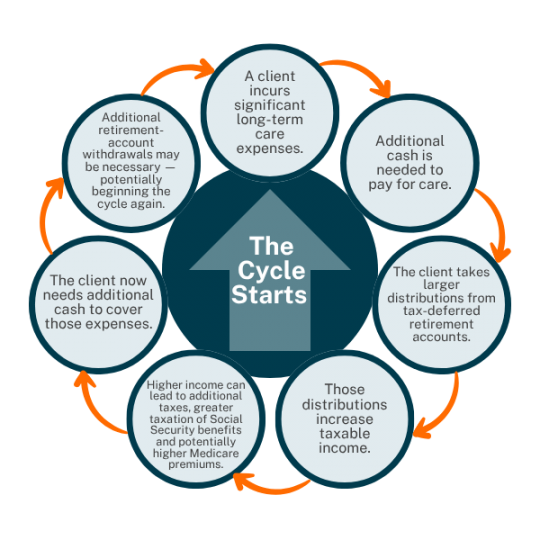
Over time, this cycle can cause retirement assets to decline faster than the client originally anticipated.
The true financial impact of an LTC event, therefore, may be substantially greater than the care bill alone.
Planning Ahead Can Help Break the Cycle
The good news is that clients don’t necessarily have to wait until an LTC event occurs before addressing the risk.
A thoughtful retirement strategy can consider where the money to pay for care will come from before care is needed.
Depending on a client’s individual circumstances, potential strategies could include:
- Traditional long-term care insurance
- Life insurance solutions with long-term care benefits
- Hybrid life/LTC strategies
- Assets specifically earmarked for future care expenses
- Coordinated retirement-income and withdrawal planning
- Collaboration with qualified financial, tax and legal professionals
The goal isn’t simply to identify enough assets to pay for care.
It’s to consider how those assets can be accessed without unnecessarily disrupting the rest of the client’s retirement strategy.
LTC Planning Is Retirement Planning
Long-term care planning shouldn’t exist in isolation.
An LTC event can potentially affect retirement income, taxes, Social Security, Medicare premiums, legacy goals and the longevity of a client’s accumulated assets.
That’s why conversations about long-term care can be an important part of a broader retirement-planning discussion.
For financial professionals, the opportunity is to help clients think beyond one question:
“How will I pay for long-term care?”
A more complete question may be:
“If I need long-term care, how will paying for it affect everything else I’ve planned for retirement?”
Helping clients answer that question before a care event occurs can provide more choices and greater flexibility.
Helping Clients Prepare for the Unexpected
Insurance and financial professionals can play an important role in helping clients understand how an unexpected long-term care need could affect their overall retirement strategy.
Futurity First provides resources and support to help financial professionals evaluate LTC, life insurance and other protection strategies that may help clients prepare for these risks.
Starting the conversation earlier can give clients more opportunities to protect retirement income, preserve assets and prepare for the financial consequences associated with an extended care event.
FOR AGENT USE ONLY. NOT TO BE USED FOR CONSUMER SOLICITATION PURPOSES.